Get in Touch
Dealers
"*" indicates required fields
The car may be at the center of automotive retail, but it is no longer the whole story.
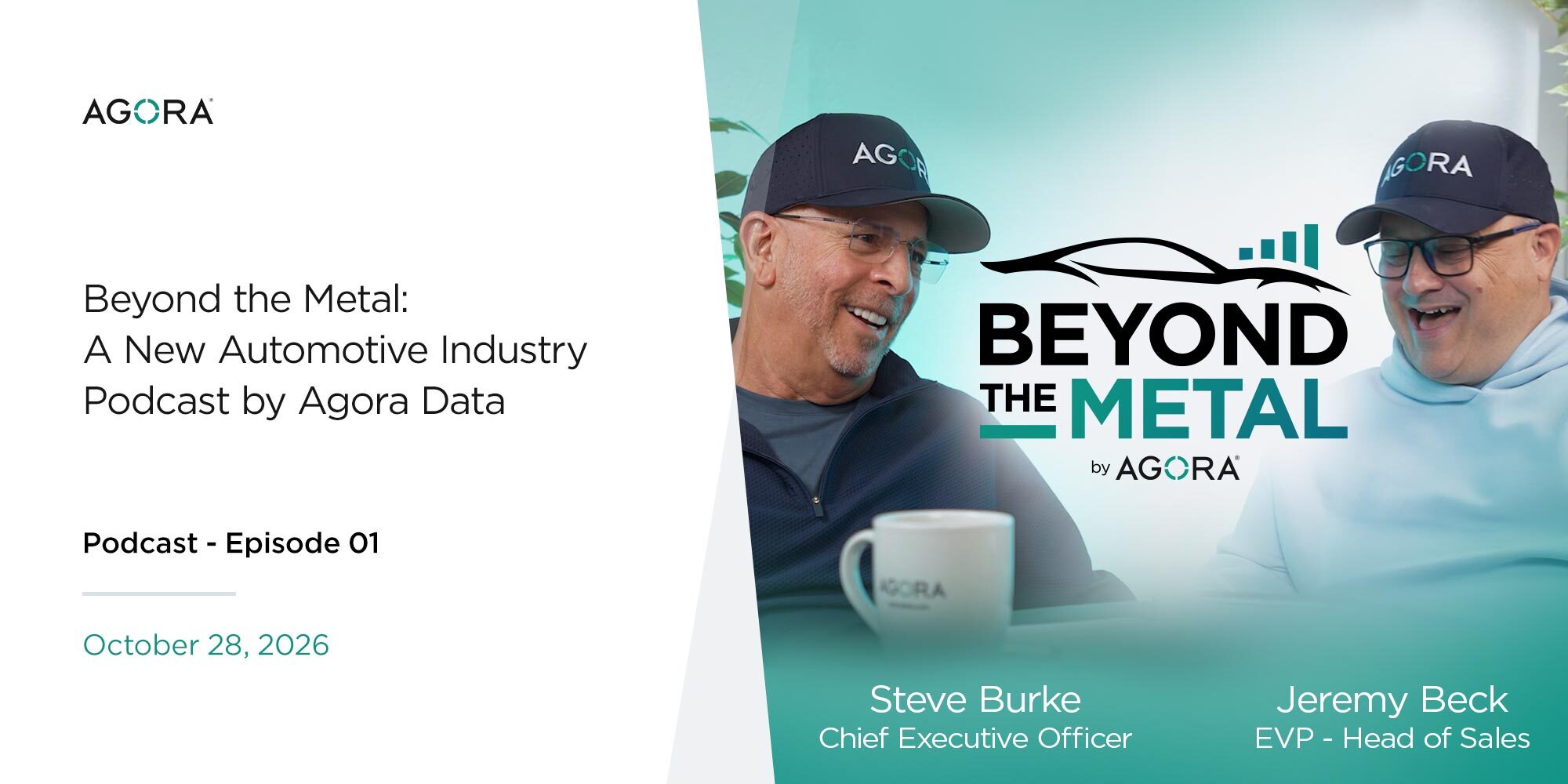
That idea is at the heart of Beyond the Metal, a new automotive industry podcast from Agora Data hosted by Steve Burke, CEO and Jeremy Beck, Executive Vice President and Head of Sales.
In the debut episode, the two automotive veterans look past the vehicle itself to examine the forces increasingly shaping dealership success, including profitability, auto financing, technology, customer relationships, data, and the rapidly changing automotive marketplace.
Want to explore how your dealership can build more value from the auto contracts you originate? Fill out the form on the right to connect with an Agora Data representative.
Watch the full podcast episode below:
Why “Beyond the Metal”?
In the car business, the “metal” is the vehicle. Auto dealers know how to acquire inventory. They know how to recondition it, price it, market it and sell it. Beyond the Metal is not about telling dealers how to do what they already do best.
As Steve Burke puts it in the first episode, “Dealers know the metal better than anyone.”
The bigger question is what happens around the metal. Today, dealership success is influenced by far more than the vehicle on the lot:
- Auto financing and capital
- Front-end and back-end profitability
- Customer relationships
- Technology and AI
- Data and analytics
- Consumer expectations
- Regulation and economic conditions
- A marketplace that is becoming less geographically defined
- And more
These are the conversations Beyond the Metal was created to explore.
The Economics of a Car Deal Are Changing
One of the central conversations in episode one is the pressure auto dealers face across traditional profit centers. Jeremy Beck draws on 27 years in automotive retail and finance. He recalls looking at dealership financial statements through three major lenses: front-end gross, back-end profit, and service profit.
Those fundamentals still matter. But the economics of the transaction continues to change.
The dealer has invested in acquiring the inventory. Then comes transportation, reconditioning, marketing, lead generation, and all the work required to turn a prospect into a car buyer.
When the vehicle finally sells, where does the value of the transaction go next?
That is where Beck and Burke challenge auto dealers to look beyond the immediate vehicle gross and consider something bigger: the financial relationship connected to that sale.
It is a natural extension of the dealership profitability conversation Agora Data is already having with auto dealers, including the importance of monitoring gross profit, F&I performance, inventory aging, funding efficiency, and contract performance.
What Happens After the Vehicle Leaves the Lot?
For decades, the traditional model has been relatively straightforward.
A dealer acquires the customer, sells the vehicle, and sends the auto contract to a third-party finance company or bank.
But the podcast raises a provocative question:
What else is the car dealership giving up when that contract leaves its ecosystem?
It is not only a potential long-term financial value. It may also mean giving another institution the ongoing financial relationship with a customer that the dealership worked hard to acquire.
Burke brings an important perspective to this conversation from more than four decades in banking and automotive finance. He describes how, from a traditional finance company’s point of view, a customer associated with a purchased contract effectively became the finance company’s customer.
That provides some context for one of the most pointed observations in the episode:
“They’re giving their customer away.”
For dealers focused on retention, repeat purchases, and customer lifetime value, protecting that relationship is essential.
A New Profit Center Beyond the Vehicle
Large automotive retailers have demonstrated that there can be significant value beyond vehicle gross alone. The challenge is that building the infrastructure to participate more directly in automotive finance has traditionally been complicated and capital-intensive.
A dealer would need to think about areas such as:
- Risk modeling
- Capital
- Contract administration
- Servicing
- Regulatory requirements
- Technology
- Portfolio performance
- Data and analytics
That is a major undertaking for an independent dealership.
The evolution Beck and Burke discuss is the ability to access sophisticated finance infrastructure without independently building an entire auto finance company from the ground up.
For Agora Data dealers, this can mean participating in the ongoing economics of eligible auto contracts while continuing to operate the dealership the way they know best.
Ultimately, the idea is straightforward: build more value for yourself instead of sending all the potential finance value to the bank.
Technology Without Reinventing the Car Dealership
There is another critical point in the episode: dealers should not have to completely reinvent their sales process to take advantage of new technology.
Beck uses a phrase that captures the philosophy well: “We will meet you where you are.”
The dealer remains an expert in operating the car dealership. Technology should support that expertise, not get in its way.
Agora Data makes submissions and eContracting available through familiar dealership platforms, including DealerTrack, RouteOne and DealerCenter.
Behind that process is a proprietary risk-pricing model that uses AI and alternative credit data to help predict contract performance. The model draws on analysis of more than $350 billion in automotive finance data.
The Meaning of a Dealer’s Market Has Changed
The podcast is not all about finance. One of its most interesting discussions examines how technology has completely changed the meaning of a dealer’s market.
Burke recalls a time when a dealer’s market was predominantly geographic. How many cars passed the dealership? How far would a customer travel? Which local advertising could bring someone onto the lot?
Today, the answer is far less defined. As Beck explains in the episode, a dealer’s market can increasingly be thought of as wherever the dealer can get a customer.
A consumer can research inventory online, compare dealerships far outside the immediate area, and complete substantial portions of the purchasing process digitally. That does not necessarily mean the physical dealership is disappearing. Instead, the opportunity is to connect both experiences.
Customers may want much of the transactional friction handled digitally while still valuing the experience of seeing, driving, and taking delivery of the vehicle. For dealers, the competitive question is no longer simply who operates nearby. It is who can create a better overall buying experience.
AI Plus the Experience Dealers Already Have
The role of data creates another compelling discussion between the hosts.
Dealers know details an algorithm may not. They understand the vehicle that just went through their shop. They know how it was reconditioned. Experienced dealers also develop valuable judgment from years of sitting across the desk from customers and structuring transactions.
At the same time, technology can analyze enormous amounts of historical information on a scale no individual dealer could replicate.
Beck and Burke agree that dealers do not necessarily have to choose between the two. The opportunity is to combine them.
AI and data can help identify patterns and provide insights into potential contract performance. Human experience adds context from the actual vehicle, transaction, and customer interaction.
Rather than replacing dealer instinct, better technology can make that experience even more valuable.
Four Takeaways for Auto Dealers
The first episode covers plenty of ground, but four ideas rise to the top:
1. Dealership profitability does not stop at the vehicle sale.
The auto contract, customer relationship and long-term economics surrounding a transaction deserve attention too.
2. The definition of a dealer’s market is expanding.
Digital retail has made geography a much less rigid boundary, giving dealers both new competitors and opportunities.
3. Data and dealer experience should work together.
Artificial Intelligence can process information at scale, while experienced dealers and auto finance experts bring valuable knowledge about vehicles, customers, and individual transactions.
4. Protecting the customer relationship matters.
Dealers invest heavily in acquiring customers. What happens to that relationship after the sale can be just as important as getting them through the door in the first place.
What Comes Next on Beyond the Metal?
This first episode establishes the foundation for a much broader conversation. Future episodes will bring in dealers and other automotive industry leaders to explore more topics around dealership profitability, auto finance, technology, consumer behavior, data, regulatory developments, and economic forces shaping automotive retail.
And that gets to the real reason for the name. The metal will always matter.
But a successful automotive business is also built around the customer, contract, capital, technology, data, and decisions surrounding that metal.
Beck summed up the opportunity well during the first episode:
“We always find a way to prevail. We always find a way to better the business.”
That resilience is part of what has always defined automotive retail.
Beyond the Metal is about exploring what dealers can do with it next. Watch Episode 1 above, then fill out the form to learn how Agora Data can help your dealership explore new opportunities beyond the traditional vehicle transaction.