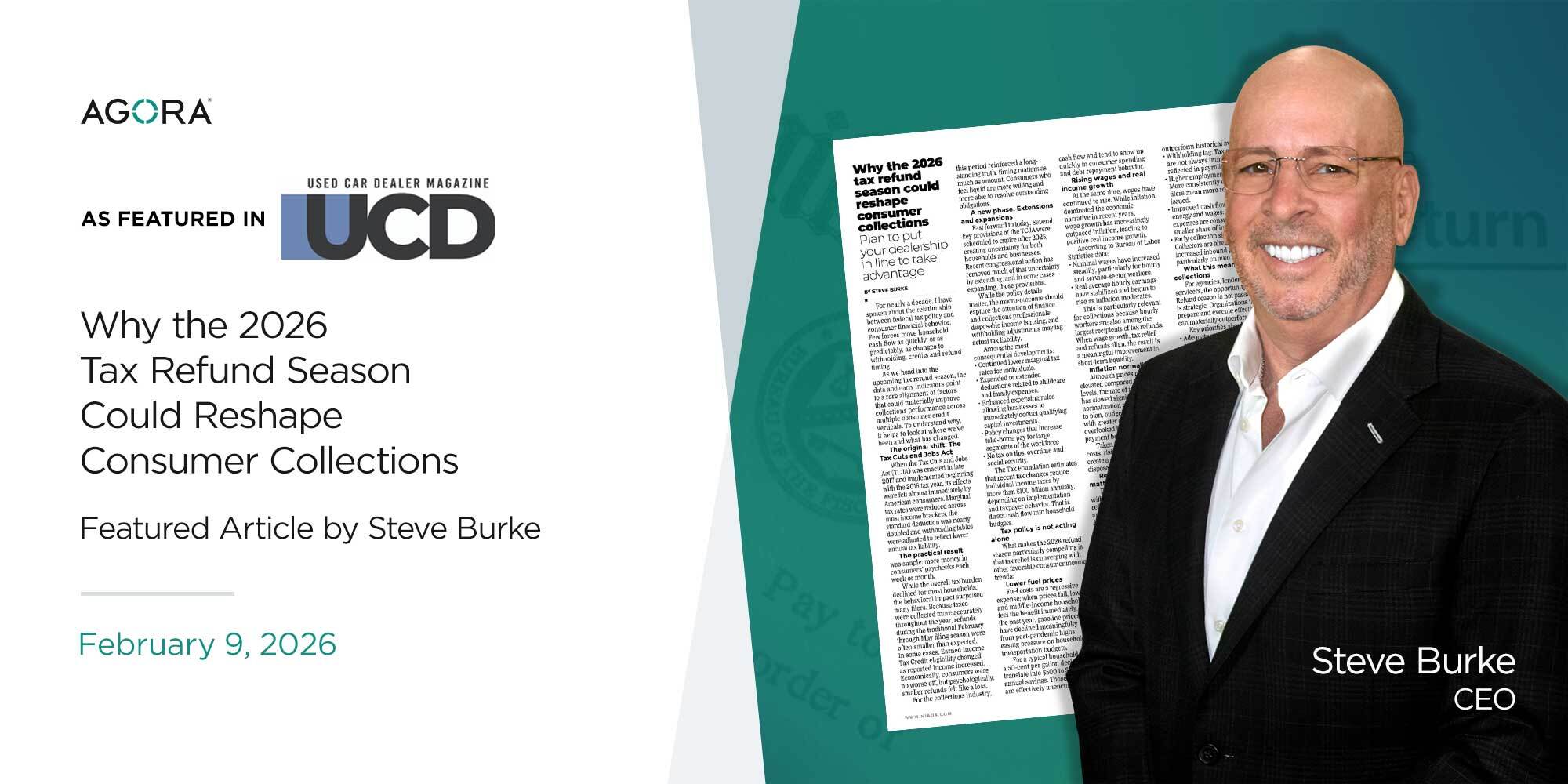
By Steve Burke, CEO Agora Data
For nearly ten years, I have written and spoken about the relationship between federal tax policy and consumer financial behavior. Few forces move household cash flow as quickly, or as predictably, as changes to withholding, credits and refund timing.
The original shift: The Tax Cuts and Jobs Act
When the Tax Cuts and Jobs Act (TCJA) passed in late 2017 and took effect starting with the 2018 tax year, its impact was almost immediately felt by American Consumers. Marginal tax rates dropped across most brackets, the standard deduction nearly doubled, and withholding schedules were updated to account for the lower annual tax liability.
The practical result was simple: More money in consumers’ paychecks each week or month. Even though total tax obligations decreased for a large share of households, the psychological effect caught many off guard. Because taxes were collected more accurately throughout the year, the refunds that typically arrive between February and May were often smaller than what filers were used to. Some also saw shifts in Earned Income Tax Credit eligibility as reported income rose. Economically, most consumers were not worse off, yet psychologically, reduced refunds felt disappointing.
A new phase: Extensions and expansions
Fast‑forward to today. Many key provisions of the TCJA were set to expire after 2025, creating uncertainty for both families and businesses planning ahead. Recent congressional action has removed this uncertainty by extending and in some cases expanding several of these provisions.
While the policy details matter, the macro-outcome should capture the attention of finance and collections professionals: disposable income is rising, and withholding adjustments may lag actual tax liability.
Among the most consequential developments:
- Continued lower marginal tax rates for individuals.
- Expanded or extended deductions related to childcare and family expenses.
- Enhanced expensing rules allowing businesses to immediately deduct qualifying capital investments.
- Policy changes that increase take-home pay for large segments of the workforce
- No tax on tips, overtime, and social security.
The Tax Foundation estimates that recent tax changes reduce individual income taxes by more than $100 billion annually, depending on implementation and taxpayer behavior. That is direct cash flow into household budgets.
Tax policy is not acting alone
What makes the 2026 refund season particularly compelling is that tax relief is converging with other favorable consumer income trends:
Lower fuel prices
Fuel costs disproportionately impact lower‑ and middle‑income households. Over the past year, gasoline prices have fallen from post‑pandemic highs, easing pressure on transportation budgets.
A decline of even $0.50 per gallon can mean $500–$700 per year in savings for a typical household. Those savings are effectively unencumbered cash flow and tend to show up quickly in consumer spending and debt repayment behavior.
Rising wages and real income growth
Wages continue to trend upward. While inflation captured the economic spotlight in recent years, wage increases have increasingly outpaced price growth, resulting in rising real income.
Based on Bureau of Labor Statistics data:
- Nominal wages have increased steadily, particularly for hourly and service-sector workers.
- Real average hourly earnings have stabilized and begun to rise as inflation moderates.
This is significant for collections because hourly workers are also among the largest refund recipients. When wage growth, tax relief, and refund season overlap, short‑term liquidity improves meaningfully.
Inflation normalization
Although prices are still above pre‑2020 levels, the rate of increase has slowed considerably. This gives households greater confidence to plan and commit to payments—an important but often underappreciated factor influencing repayment behavior.
Together, lower fuel costs, wage growth, and tax relief create a multiplier effect on disposable income.
Refund season still matters
Even with ongoing changes to withholding practices, tax refunds remain the biggest single cash influx many Americans receive each year.
IRS data shows:
- Over 117 million refunds are issued annually.
- Total refunds exceed $460 billion per year.
- The average refund in recent seasons has ranged from $2,800 to over $3,000.
Behavioral research consistently finds that consumers treat refunds differently than regular paychecks. Refunds feel like “extra money,” making them far more likely to be used for lump‑sum payments, settlements, or clearing past‑due accounts.
Why this season looks different
Several dynamics suggest the 2026 refund season could outperform historical averages:
- Withholding lag: Tax changes are not always immediately reflected in payroll systems.
- Higher employment stability: More consistently employed filers mean more refunds issued.
- Improved cash flow from energy and wages: Everyday expenses are consuming a smaller share of income.
- Early collection signals: Collectors are already reporting increased inbound payments, particularly on auto loans.
What this means for collections
For lenders, servicers, and agencies, the opportunity is substantial.
Refund season shouldn’t be viewed as passive—it’s a strategic period. Organizations that plan ahead can significantly outperform their peers.
Key focus areas include:
- Adequate staffing during peak refund weeks.
- Targeted outreach to refund-sensitive segments.
- Emphasis on first-dollar capture before discretionary spending occurs.
- Tight coordination with vendors and servicing partners.
Looking beyond this year
Most importantly, these trends are not isolated to a single filing season. With greater clarity in tax policy, easing inflation, and ongoing wage gains, the next several years may offer an extended period of improved household liquidity.
For the collections ecosystem, this presents a valuable opening to resolve older balances, boost recovery performance, and reinforce portfolio strength.
Final thought
Tax policy often dominates the headlines, but it is the combination of tax relief, lower energy costs and rising real incomes that ultimately drives consumer behavior. This year, those forces are aligning. Consumers will have the money.
For the auto sector, these trends create a strong opportunity to drive additional sales as tax‑refund season puts more cash in the consumers’ hands and brings additional buying power into the market. The question is how to be positioned to collect it first!
To read the full article click here.
For additional industry insights, visit https://niada.com.